How to Make Patio Furniture More Comfortable
To make patio furniture more comfortable, adjust the seat angle and add targeted support where your body meets the frame, then arrange seating so people face each other at a relaxed distance. Small changes to height, cushioning, and layout do more than buying a whole new set.
On this page (7 sections)
- Why does patio furniture feel uncomfortable in the first place?
- How do you adjust seating so the chair fits your body?
- What add-ons make the biggest difference to comfort?
- How should you arrange patio seating for comfort?
- How do you handle sun, heat, and glare?
- How do you keep the furniture comfortable over time?
- Which comfort fix should you try first?
To make patio furniture more comfortable, adjust the seat angle and add targeted support where your body meets the frame, then arrange seating so people face each other at a relaxed distance. Small changes to height, cushioning, and layout do more than buying a whole new set.
Comfort on a patio comes from three things you can control: how the furniture sits, what you put on it, and how it is arranged. This guide covers each in order, so you can fix the worst problem first.
Why does patio furniture feel uncomfortable in the first place?
Most patio furniture feels uncomfortable because the seat is flat, hard, and set at a depth that doesn't match your legs, not because the design is bad. Wood slats, metal mesh, and molded plastic all put pressure on a few points.
A seat that is too deep makes you slouch to reach the backrest. A seat that is too high leaves your feet dangling.
Hard surfaces without cushioning press into the hips and tailbone after 20 minutes or so.
Sun and heat add to the problem. A dark seat in direct sun gets hot enough that you shift around instead of settling in.
Fixing posture and heat together is the core of learning how to make patio furniture more comfortable.
Seat depth is the spec most people never check. A chair with a deep seat and a short backrest asks your spine to do the work the frame should do.
A chair with a low backrest leaves the shoulders and neck unsupported, so you lean forward to talk and your lower back rounds. Those two misses cause more shifting and fidgeting than any other part of the frame.
How do you adjust seating so the chair fits your body?
Set the seat height so your feet rest flat and your knees sit near a right angle, then check that the backrest meets your lower back without a gap. These two checks catch most fit problems.
For a chair that is too high, a small footrest or a thick outdoor rug under the seat helps. For one that is too deep, a lumbar pillow or a rolled towel behind your back shortens the usable depth.
Armrests should let your shoulders relax. If they sit too low, your arms hang and your neck tightens; if too high, your shoulders rise.
A thin pad on the armrest can raise a low one by an inch or so.
Do this check on each seat you use most. A chair that fits well needs less cushioning than one that doesn't.
Height and depth are easy to test in a minute. Sit all the way back and slide a hand behind your lower back.
If the hand fits with room to spare, the seat is too deep for you. Then look down at your feet.
If your heels don't touch the ground, the seat is too high and you will perch on the edge, which loads the tailbone instead of spreading weight across the thighs. Both fixes cost little and take minutes.
What add-ons make the biggest difference to comfort?
Seat cushions and a lumbar pillow give the most comfort per dollar, followed by shade and a place to set a drink. Start with the seat you sit in longest.
Look for a cushion 2 to 3 inches thick with a tie or grip base. A cushion that slides forward when you stand is more annoying than a hard seat.
Check that the added height still lets your feet reach the ground.
A lumbar pillow does a different job than a seat cushion. The seat cushion spreads weight under the hips and thighs, while the lumbar pillow fills the gap behind the lower back so the spine keeps its natural curve.
On a slat-back chair, a slim lumbar roll is often enough, because the slats already give the back some support.
Which chairs already solve part of the comfort problem?
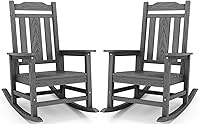
Some chairs are built with the posture support already in place. The Shine Company Vermont Oak Rocking Chair has a high backrest, rounded armrests, and an ergonomic seat, so it supports the back and arms without extra pads.
It is solid acacia hardwood with a painted finish and a wood sealant for outdoor use. The wood is kiln-dried to guard against cracking, splitting, and warping.
The rocker arrives partly assembled with rust-resistant hardware. Its 20.5 inch backrest width and 27 inch arm height suit average adult frames, and the rocking motion helps people settle rather than sit stiffly.
At 20 pounds it is light enough to shift out of the sun. {{product B0H2J6Q5L5 | A high-back acacia rocker with ergonomic seat support built in, so it needs fewer add-on pads.}}
For a shared seat, the VINGLI 5 ft Wooden Porch Swing has an ergonomic curve at the knee area and adjustable chains so you can set the seat angle. It holds up to 880 lb and seats up to 3 people.
The chains lock to the wood frame for security, and the coated surface is more durable than raw wood. Two people can assemble it in about 20 minutes.
The cedar seat has a 15.4 inch depth and the frame spans 60.6 inches wide. {{product B08XBGL8GM | Adjustable chains let you tilt the seat to a restful angle, and the curved knee area eases long sitting.}}
If you want a chair that changes with your mood, the PASAMIC Adirondack Rocking Chairs Set switches between rocking, rocking with a retractable ottoman, fixed seating, and fixed with ottoman. Each chair has dual cup holders and a phone slot.
The all-weather HDPE frame supports up to 330 lb and folds flat when the rocking base is removed. The seat is 18 inches deep. {{product B0H93KWF2J | Four seating modes plus a pull-out ottoman let each person set their own comfort level.}}
How do you keep a swing from cutting into your legs?
A porch swing feels uncomfortable when the front edge digs into the back of the thighs. The cause is usually a seat that is too shallow or a swing hung too low.
The VINGLI swing meets the knee area with a curve rather than a straight edge, and its adjustable chains let you tilt the seat so your weight settles back.
If the front edge still bites, raise the swing slightly and check that your feet reach the floor. A flat seat with the legs dangling puts all the load on the thigh edge.
How should you arrange patio seating for comfort?
Pull seats into a loose U or a pair facing a small table, leaving about 18 inches between chairs so people can turn without bumping elbows. Facing each other at a relaxed distance feels better than a straight row against a wall.
Keep the main conversation group close, roughly 3 to 5 feet across. Wider spacing makes people raise their voices and lean forward.
Leave a clear path behind the seats so nobody has to climb over a chair to reach the door. Put the most-used seat out of the direct afternoon sun.
A small side table within arm's reach reduces twisting and reaching. That one change often does more for comfort than a thicker cushion.
It also gives a rocker or swing user a steady place to set a drink so they don't balance a cup on an armrest.
How do you handle sun, heat, and glare?
Add shade over the main seating area first, because a hot seat is uncomfortable no matter how well it fits. An umbrella, awning, or pergola over the group cools the seat and cuts glare.
Choose light-colored cushions and covers on a sunny patio. Dark surfaces absorb heat and stay warm long after the shade moves.
On a west-facing deck, shade the seating from mid-afternoon. A simple offset umbrella over two chairs is enough for a small space.
For wind exposure, review our guide to wind resistant patio furniture so comfort upgrades don't blow around. A chair that shifts in the breeze undoes the fit you set.
How do you keep the furniture comfortable over time?
Clean the frames and cushions on a schedule and store or cover them when the season ends, because dirt, mildew, and worn foam all reduce comfort. A gritty seat and a flattened cushion feel worse than they look.
Wash frames with mild soap and water and let them dry fully before use. Our guide to how to clean patio furniture at home covers wood, metal, and plastic care in detail.
Bring cushions in during rain or store them in a dry box. Foam that stays damp loses its shape and support.
Tighten any loose hardware each spring. A wobbly chair feels unstable and makes people sit tense.
On a wooden rocker or swing, check the joints and the chain connection points before the season starts. For heavier users, the weight ratings in our guide to patio furniture for heavy people help you choose a frame that stays solid.
If you are choosing new pieces, HDPE patio furniture resists fading, cracking, and rot, so it holds its shape and comfort through wet seasons. That matters for comfort because a frame that warps or sags changes the seat angle you worked to set.
Which comfort fix should you try first?
Fix the seat you use most, starting with fit and support, then work outward to shade and layout. Reorder the fixes only if heat or wind is your main complaint.
Pick a seat cushion and lumbar pillow for a hard chair. Adjust the chains on a porch swing to set a restful angle.
Add shade over the group before buying more furniture.
Replace the furniture only when the frame itself is the problem: too high, too deep, or too weak for the people using it. Otherwise, the adjustments above answer how to make patio furniture more comfortable for far less than a new set.
Start with the chair you sit in every evening. One cushion, one shade sail, and one rearranged pair of chairs will change how the whole patio feels.
Frequently asked questions
How much does it cost to make patio furniture more comfortable?
Most comfort fixes are cheap: a seat cushion, a lumbar pillow, or a small side table often costs less than a full replacement set. Spend first on the seat you use most, and only replace furniture when the frame itself is the problem.
Do seat cushions help hard wooden chairs?
Yes. A 2 to 3 inch cushion takes pressure off the seat bones and warms up a hard slat seat.
Look for a cushion with a tie or grip base so it stays put when you stand up, and check that it does not make the seat too high for the armrests.
What is the best seating arrangement for a small patio?
Pull chairs into a loose U or a pair facing a small table, leaving about 18 inches between seats so people can turn without bumping. A tight row along one wall feels less comfortable than two chairs angled toward each other.
Can I change the angle of a porch swing?
Yes. On a swing with adjustable chains, shorten or lengthen the chains to change the seat angle.
A slight backward tilt is more restful for long sitting, while a flatter seat makes it easier to get in and out.
Should I add shade to a sunny patio?
Shade is one of the most effective comfort upgrades on a hot patio. An umbrella, awning, or pergola over the main seating area keeps the seat cooler and reduces glare, which matters more than cushion thickness on a west-facing deck.