Cast Aluminum vs Cast Iron Patio Furniture: Which Is Better? (November 2026)
Choose cast aluminum for most patios because it won't rust and stays light enough to move. Pick cast iron only when you want maximum heft and a spot that stays put, and accept that it needs paint upkeep to hold off rust.
On this page (8 sections)
- Cast aluminum vs cast iron: which metal handles weather better?
- Which metal set is easier to move and rearrange?
- How much weight will each metal carry?
- How much care does each metal need?
- Cast aluminum vs cast iron for small spaces
- How does the mixed-metal bench compare?
- Who should buy which?
- Verdict: which metal wins?
Choose cast aluminum for most patios because it won't rust and stays light enough to move. Pick cast iron only when you want maximum heft and a spot that stays put, and accept that it needs paint upkeep to hold off rust.
The cast aluminum vs cast iron patio furniture question comes down to three things: how the metal handles rain, how much it weighs and how much care you'll put in. This comparison uses three real sets to show where each metal helps.
Two of them are bistro sets, one all-aluminum and one with a cast iron frame. The third mixes cast iron supports with aluminum panels, which makes it a useful middle case.
 Best for a mixed-metal two-seater
VINGLI 38.5" Patio Park Garden Outdoor Metal
Cast aluminum vs cast iron: which metal handles weather better?
Cast aluminum wins on weather because it doesn't rust. Cast iron rusts as soon as its paint or powder coat breaks, and outdoor furniture gets chips from chairs, toys and garden tools.
Aluminum forms a thin oxide skin when it meets air and moisture. That layer stays put and shields the metal underneath.
The C/G set leans on this, using die-cast aluminum for the table and both chairs with a powder-coated surface on top.
Cast iron behaves the other way. Once moisture reaches bare iron, rust spreads under the surrounding paint and lifts it off.
The VINGLI bench shows how makers handle this: cast iron supports do the load bearing, while aluminum tubes form the seat panel, armrests and backrest.
That split is smart, but it doesn't make the cast iron parts rust-proof. Check the feet and any joint where paint wears thin, and touch up bare spots before winter.
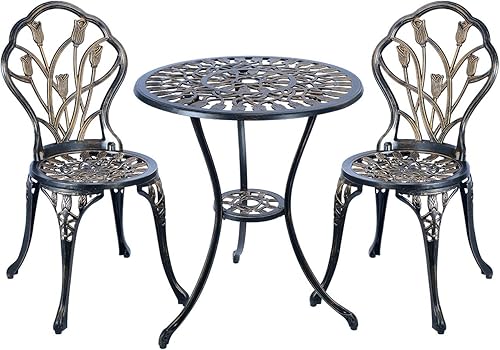
The Withniture set's listed material type is cast iron, so treat it as the iron-framed option here and expect more paint care than an aluminum set.
What finishes do to the rust question
A powder coat or painted finish is the real shield on either metal. On cast iron it's the only shield.
Scratches matter more there, because one chip is enough to start a rust spot.
The VINGLI bench uses a bronze antique finish that hides small marks better than a bright color. The bistro sets use copper and brown tones for the same reason.
None of them is bare metal, so all three depend on that coating staying intact.
Wipe each set with a dry cloth, and avoid scouring pads that cut through the finish. If you store a set through a wet season, a cover keeps standing water off the coating.
Which metal set is easier to move and rearrange?
Cast aluminum is far lighter, so it's the easier choice if you rearrange often or store furniture seasonally. Cast iron's weight is an advantage only when you want a piece to stay exactly where you put it.
Weight shows up clearly in these three sets. The VINGLI bench weighs 20.7 lb despite seating two people.
The C/G bistro set comes in at 26.2 lb for a table and two chairs. The Withniture set is the heaviest at 40 lb for the same three pieces.
None of those numbers is heavy by patio standards. A pure cast iron bench of the same size would weigh considerably more, which is why so much cast iron seating stays in one spot for years.
For a balcony, a rented patio or a yard where you shift shade through the day, lighter matters. For a windy exposed deck, heavier helps.
Moving a bench versus moving a bistro set
A bench is one piece, so you carry it in one trip. The VINGLI's 20.7 lb makes that a one-person job for most adults, and its 38.5 in width fits through a standard gate.
A bistro set is three pieces. You can move the table and each chair separately, which is easier on stairs but means more trips.
The C/G set's light weight suits people who need to move furniture often, while the Withniture set takes more effort at 40 lb.
When weight becomes a safety feature
On an open, windy site, a light bistro set can slide or tip in a gust. The C/G set's 26.2 lb and the Withniture set's 40 lb both sit light enough that wind is worth thinking about.
That's where cast iron earns its place. A heavier base stays put, and the VINGLI bench combines that with a 500 lb weight rating on its cast iron supports.
If your patio catches strong wind and you don't want to anchor furniture, weight works in your favor.
How much weight will each metal carry?
Cast iron carries more per part, but cast aluminum sets are rated well enough for normal seating. The rating on each piece matters more than the metal name.
The VINGLI bench is rated to 500 lb across two seats. Its cast iron supports do that work, and the aluminum panels only form the seating surface.
That's a strong number for a bench this light.
The bistro sets differ from each other. The C/G chairs are rated to 250 lb each.
The Withniture chairs are rated to 396 lb each, with a table limit of 200 lb.
Those gaps matter for larger sitters. A 250 lb chair limit leaves little margin, while 396 lb covers most adults comfortably.
If you host bigger guests, the Withniture set is the safer pick on this point alone.
Where the metal type stops mattering
Once a frame is rated for the people who'll sit on it, the metal type stops being the deciding factor. A 396 lb chair is stronger in use than a 250 lb one, whatever the base metal.
Read the rating per seat, not per set. A two-person bench rated to 500 lb is a 250 lb seat, roughly the same as each C/G chair.
The VINGLI's advantage is that its cast iron supports are engineered for that load.
How much care does each metal need?
Cast aluminum needs almost no care beyond cleaning. Cast iron needs cleaning plus periodic paint checks and touch-ups.
That difference adds up over years outdoors.
For the aluminum set, care is simple. The C/G set can be cleaned by washing with water, and it wipes down with a dry cloth.
There's no rust to chase and no paint to renew.
The Withniture set, with its cast iron frame, and the VINGLI bench need more attention on their iron parts. Wipe them with a dry cloth, and look over the supports and feet each season.
Any spot where the finish has worn should get a touch-up before wet weather arrives.
Covers help all three. A cover keeps rain and leaf debris off the finish and, on the iron-framed sets, keeps water out of the joints around the cast iron.
Assembly and setup effort
The VINGLI bench takes about 15 minutes for one person to assemble, with instructions, screws, nuts and washers in the box. That's quick for a metal bench.
The C/G set includes an instruction sheet and the fittings needed for its table and two chairs. The Withniture set also ships with a manual and complete accessories.
Neither bistro set is complicated, but each has more parts than the single bench.
The Withniture set adds adjustable leveling feet on every leg, which help on uneven paving. The C/G set has adjustable foot pads for the same reason.
Level feet reduce wobble, and wobble is what loosens joints over time.
Cast aluminum vs cast iron for small spaces
Cast aluminum is the better fit for balconies and small patios, because it's lighter and won't rust in exposed spots. A compact bistro set makes the most of limited floor space.
The C/G set fits a tight corner with its 23.6 in round table and two chairs. The Withniture set is close in size at 24 in across the table.
Either set seats two without eating up a whole balcony.
Both tables have an umbrella hole. The C/G hole is 1.75 in and the Withniture hole is 1.97 in, so check your umbrella pole before you buy.
A larger hole fits more poles but may need a ring to hold a thin one steady.
If you want a compact aluminum set and don't need shade, our roundup of the best aluminum patio furniture sets covers more options. If you like the woven look instead of smooth metal, the best wicker patio furniture sets are worth a look, and our guide to wicker vs rattan explains what those names actually mean.
How does the mixed-metal bench compare?
The VINGLI bench shows that you don't have to choose one metal for the whole piece. It pairs cast iron supports with aluminum seat, arms and back, so the rust-prone parts are small and the large panels stay rust-free.
That design has a clear logic. Cast iron is strongest where it carries load, at the supports and frame.
Aluminum is lightest and most weather-resistant where it forms the seat and back, which are also the parts you touch and see most.
The result is a two-person bench that weighs 20.7 lb and holds up to 500 lb. It's light enough to move but steady enough to leave out.
The trade-off is that the cast iron parts still need paint care, so it's not quite as hands-off as the all-aluminum set.
For a seating spot where you want a decorative piece rather than a table set, this is a strong middle option. Our Wisteria Lane patio furniture review covers another approach to mixed materials if you're comparing full dining sets.
Seat comfort and depth
The VINGLI bench has a 13.5 in seat depth, which is on the shallow side. That suits upright sitting and short coffee breaks more than long lounging.
The bistro chairs are also compact. The C/G seat is about 16.5 in across, while the Withniture chair has a hollow back and seat to let air move.
On a hot day, the airflow design stays cooler than a solid metal seat.
Cushions change the picture. They add depth and comfort, but on the Withniture set they'd block the hollow airflow.
On the VINGLI bench, a thin pad would soften the shallow seat without making it too deep.
Who should buy which?
Most buyers should pick a cast aluminum set. It won't rust, it's lighter to move and it needs less upkeep over its life outdoors.
That covers renters, balcony owners and anyone who rearranges furniture through the season.
The C/G 3 Piece Bistro Set is the pick for a compact balcony or small deck. Its cast aluminum table and chairs, adjustable foot pads and umbrella hole cover the basics for two people.
The Withniture Bistro Set 3 Piece Outdoor Bistro is the pick when you seat heavier guests or want a bigger umbrella hole. Its 396 lb chair rating is the highest in this comparison, and the hollow seat design suits hot climates.
The VINGLI 38.5" Patio Park Garden Outdoor Metal is the pick when you want a bench and don't mind a little cast iron care. Its mixed frame gives you cast iron strength where it counts and aluminum panels that won't rust.
Skip cast iron furniture entirely if you want zero paint upkeep or your set sits in constant damp. Skip cast aluminum only if wind is a serious problem and you can't anchor the set.
Verdict: which metal wins?
Cast aluminum wins for most patios, and the VINGLI bench is the best overall pick here because it puts the metal where each type works best. Its score of 9.7 reflects the 500 lb cast iron support, the rust-resistant aluminum seat and arms, and a 20.7 lb weight that's easy to move.
The all-aluminum C/G bistro set is close behind. The C/G set at 9.5 is the lighter, simpler choice for a balcony, and the Withniture set at 9.1 is the sturdier seating option for two with a wider umbrella hole.
For a mixed-metal piece that reads as cast iron strength without the full weight or the full rust risk, the VINGLI bench is the one to choose. Buy cast iron when you need weight to anchor a set in wind and you'll keep up with paint touch-ups.
Otherwise, cast aluminum is the metal that makes patio life easier.
Frequently asked questions
Is cast aluminum or cast iron better for patio furniture?
Cast aluminum is better for most patios because it won't rust and is light enough to rearrange. Cast iron is heavier and more stable in wind, but it rusts once the paint chips and needs periodic repainting.
Does cast aluminum patio furniture rust?
No. Aluminum forms a thin oxide layer that protects the metal instead of flaking away like iron rust.
That's why cast aluminum sets like the C/G bistro hold up in rain without paint upkeep.
Why is cast iron so heavy?
Cast iron is dense, so the same part weighs far more than cast aluminum. That weight keeps a bench from sliding or tipping in wind, but it also means you'll want two people to move a cast iron piece.
Can cast iron patio furniture stay outside all winter?
It can, but only with intact paint. Any chip or scratch lets moisture reach the iron and start rust, so touch up bare spots before winter and check the feet where water collects.
Which metal stays cooler in direct sun?
Aluminum heats up faster than iron in direct sun, so a bare cast aluminum seat can feel hot on a bright afternoon. Shade, a cushion or a lighter finish helps; iron warms more slowly but holds heat longer.
Do these metal sets need covers?
A cover helps any metal set last longer. It keeps standing water and debris off the finish, and on a mixed set like the VINGLI bench it protects the cast iron feet that are the most rust-prone part.